
Why joined-up delivery matters more than ever
With empty dwellings rising, temporary accommodation pressures still high, and councils under pressure to do more with existing stock, empty homes work needs better visibility, better workflow, and better connection to wider housing services.
Empty homes are often discussed as a niche housing issue. They are not. In practice, they sit right in the middle of several of the biggest pressures facing councils today: housing supply, homelessness prevention, temporary accommodation demand, neighbourhood standards, retrofit, and long-term service efficiency.
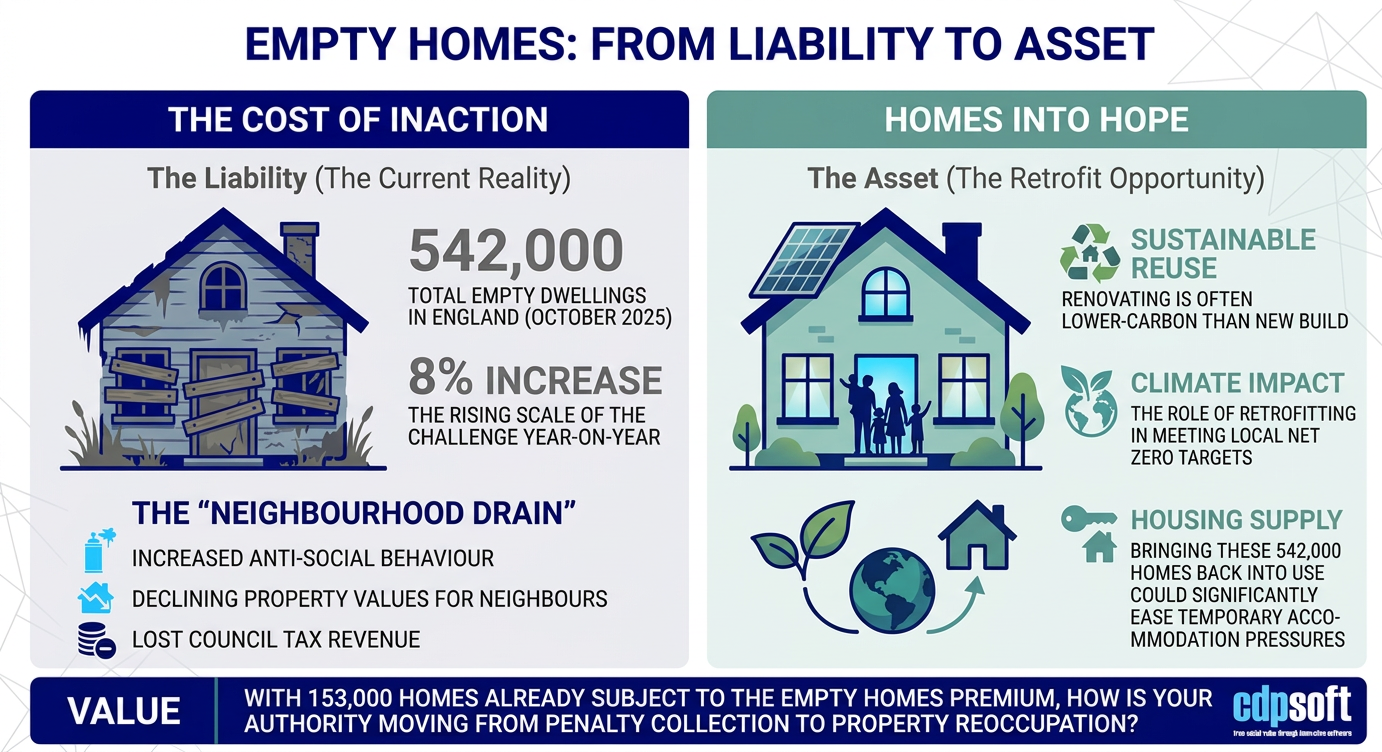
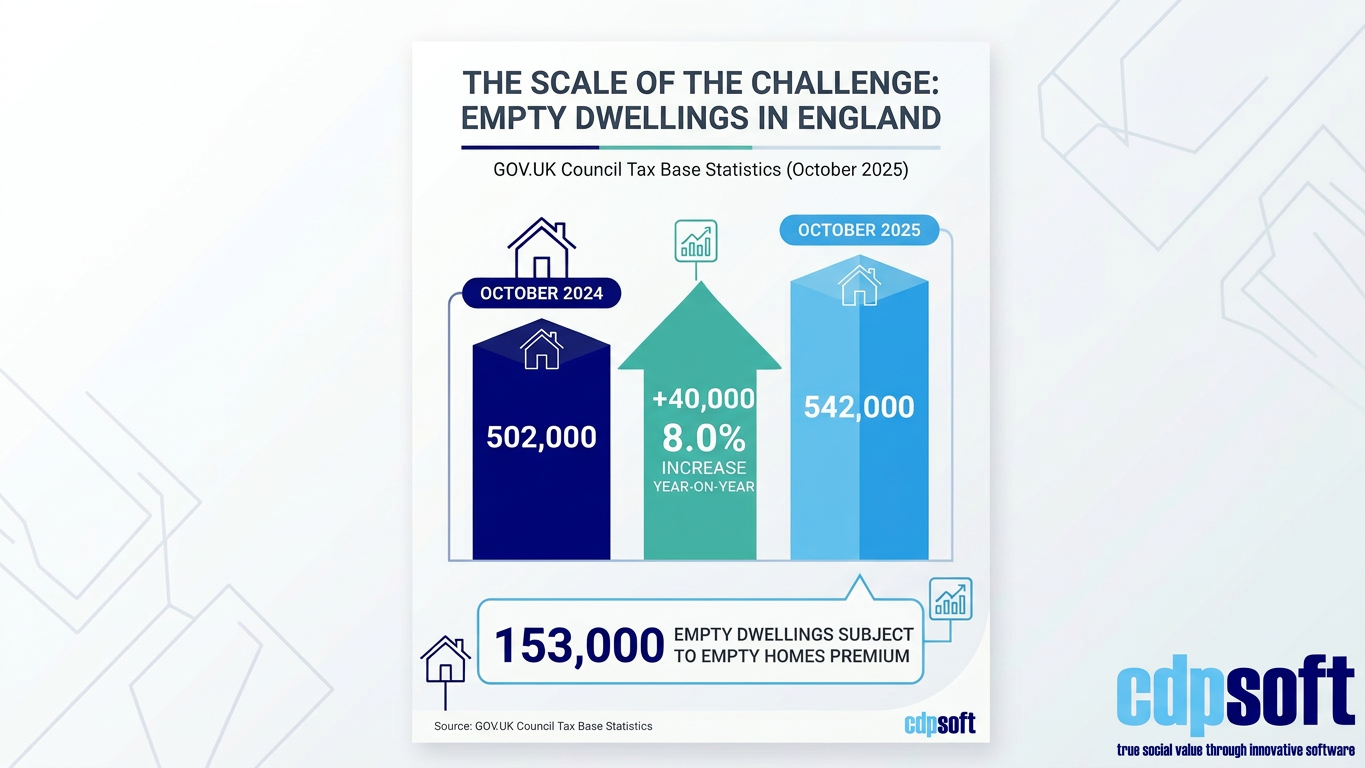
The latest council taxbase statistics show that, excluding exempt properties, there were 542,000 empty dwellings in England in October 2025, up by 40,000, or 8.0%, on the year before. The same release reports that 153,000 empty dwellings were subject to an Empty Homes Premium. Those numbers matter because they point to a substantial volume of underused stock at exactly the point when many councils are trying to widen access to settled housing and reduce pressure elsewhere in the system.
The wider housing context makes that challenge harder to ignore. Government figures show that 132,410 households were living in temporary accommodation in England on 30 June 2025, up 7.6% year on year. Separately, the rough sleeping snapshot for autumn 2025 recorded 4,793 people sleeping rough on a single night in England, the fourth annual increase in a row and the highest figure recorded since the current snapshot approach began. Empty homes are not a complete answer to those pressures, but they are one of the clearest opportunities to recover supply from homes that already exist.
That is part of the reason National Empty Homes Week 2026 has carried more weight this year. The campaign, organised by Action on Empty Homes, from 9 to 15 March 2026 under the theme “Homes into Hope: Impact in our communities”. Its focus was clear: retrofit, renovation, sustainable reuse, housing supply, and climate impact. The campaign also framed empty homes work as something bigger than enforcement or casework alone. It positioned it as a practical way to strengthen communities, improve neighbourhoods, and make better use of existing assets.
Why this work now demands more structure
There has been a tendency in some places to treat empty homes activity as a specialist sideline. The reality is more demanding. The Local Government Association has been explicit that bringing empty homes back into use can play a key part in local strategies to meet housing need. Its guidance goes further than broad encouragement. It points councils towards practical service disciplines such as identifying empty properties, maintaining an empty homes database, prioritising cases, progressing interventions, and building a more proactive operating model.
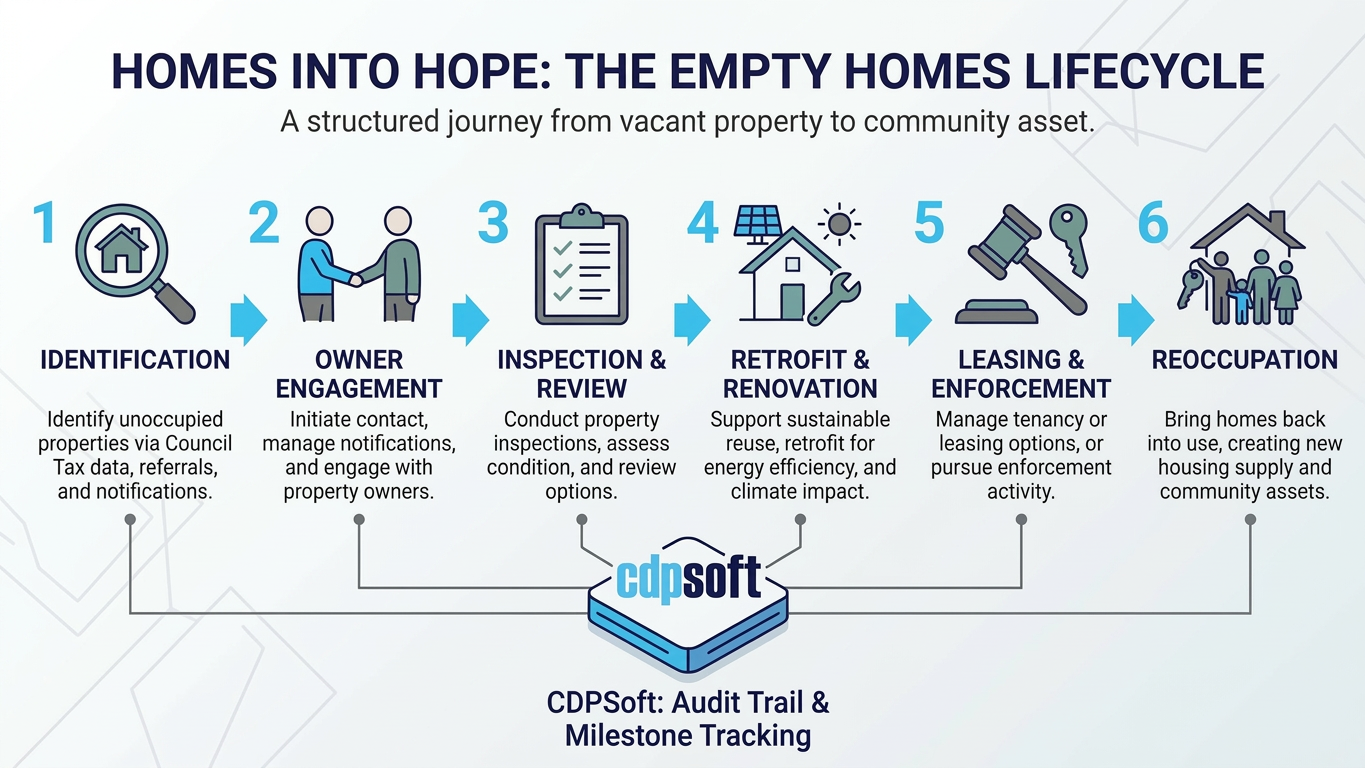
That matters because the work itself is rarely linear. A property may enter the system through council tax data, a referral, local intelligence, a complaint, or partner information. From there, the case may move through owner engagement, inspection, condition review, options appraisal, leasing discussions, grant or loan considerations, enforcement, and eventually reoccupation. At every stage, the service needs a reliable record of what has happened, what is due next, and what outcome is being pursued.
Without that structure, cases easily become fragmented. Activity gets spread across inboxes, spreadsheets, phone notes, and disconnected systems. Oversight weakens. Reporting becomes manual. Bottlenecks become harder to spot. Strategic value becomes difficult to demonstrate.
Policy has shifted too
The operational need for stronger case management has increased because the policy position has changed. Since April 2024, councils in England have been able to apply the Empty Homes Premium once a property has been empty for one year, rather than the previous two-year threshold. That gives councils a stronger lever, but it also raises the bar on case evidence, record keeping, and defensible decision-making. If services are going to use those tools well, they need consistent data, clear audit trails, and better visibility of case progression.
There is also a growing climate argument. Action on Empty Homes says that bringing empty homes back into use through retrofit and renovation can use 50 to 80% less embodied carbon than building new homes, while also helping to create more energy-efficient housing. That gives empty homes work a wider relevance than housing supply alone. It links directly to sustainability, energy efficiency, and the cost of poor-quality stock.
From workflow challenge to strategic opportunity
This is where the conversation should move on. Empty homes work is not just about finding vacant properties. It is about managing a pipeline of opportunity. Every property brought back into use has the potential to contribute to wider housing objectives, whether that is preventing homelessness, easing pressure on temporary accommodation, widening housing procurement options, or improving neighbourhood stability.
The difficulty is that this strategic contribution is often hidden by operational fragmentation. Services may know they are working hard, but still struggle to answer straightforward leadership questions. How many cases are active. Which stage are they at. Where are the delays. How many properties are moving back into use. What is the link between empty homes work and wider housing outcomes.
That is why empty homes and housing procurement benefit from a more joined-up management approach. Better workflow is not just an admin gain. It is how services turn dispersed activity into measurable supply, clearer performance, and stronger operational confidence.
How CDPSoft supports Empty Homes and Housing Procurement
CDPSoft supports Empty Homes and Housing Procurement through configurable case management designed for real housing workflows, not one-size-fits-all process maps.
At the front end, that means helping services capture and manage incoming empty homes activity in a structured way. Cases can be recorded consistently, whether they originate from council tax-led notifications, public referrals, officer intelligence, or partner information. From that point onward, each case can follow a trackable process rather than becoming another isolated record.
That becomes especially valuable once the work becomes more complex. Owner contact, review activity, inspection outcomes, internal actions, tenancy or leasing options, enforcement stages, and reoccupation plans all need to be visible. Teams need to know what has happened, what evidence is on file, what action is due, and where responsibility sits. CDPSoft supports that through configurable workflows, milestone tracking, audit trails, document management, and reporting.
The result is a clearer operational picture. Officers can see where each property sits in the process. Managers can monitor overdue actions, stalled cases, and outcome trends. Services can move away from reactive handling and towards a more deliberate, proactive model, that aligns with the LGA’s Empty Homes officer toolkit
A joined-up housing view matters
Another weakness in empty homes delivery is treating it as separate from everything else. In reality, it is tied to wider housing performance.
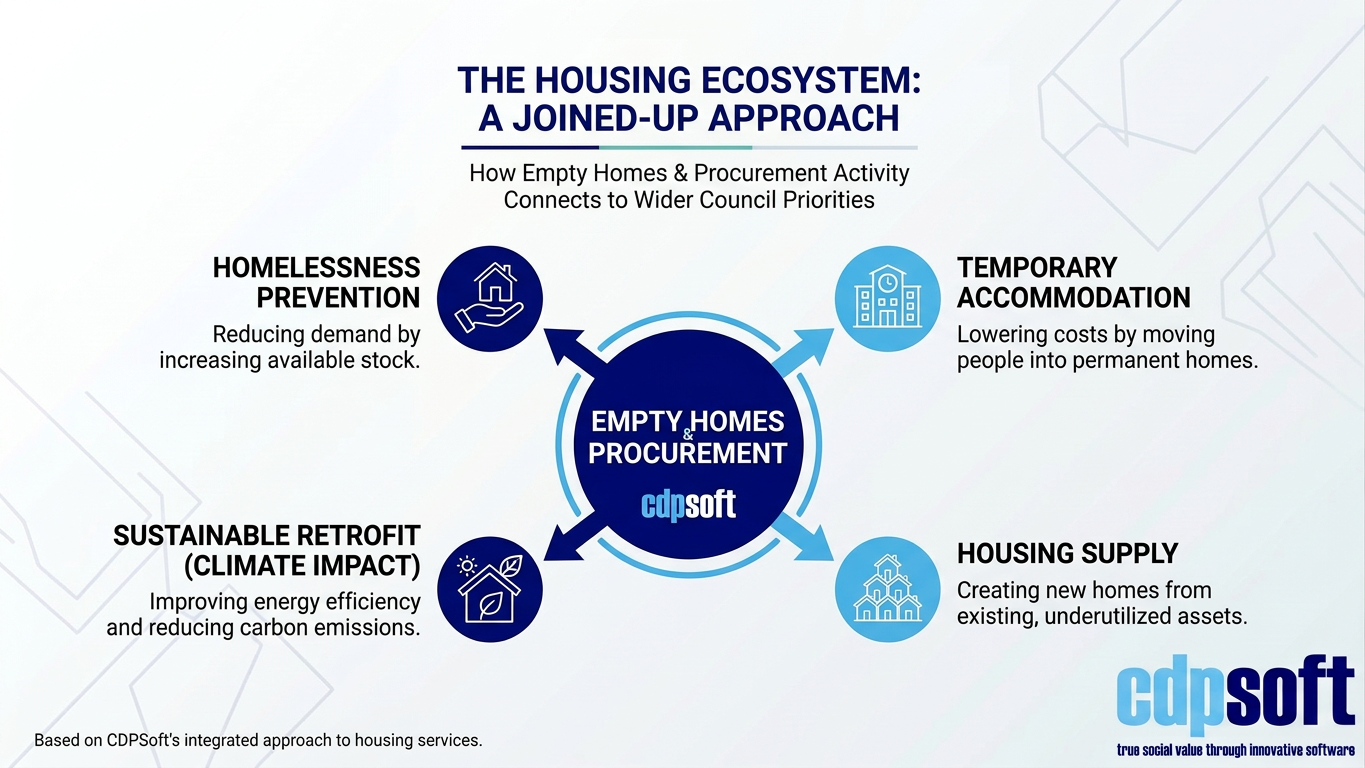
Bringing an empty home back into use can reduce pressure on homelessness services by widening available stock. It can support temporary accommodation strategies by increasing settled options. It can contribute to housing procurement goals by converting underused assets into viable homes. It can also align with retrofit and decarbonisation ambitions where renovation improves energy efficiency and reduces waste.
That is why CDPSoft’s role here is not simply about recording empty homes cases. It is about supporting a connected operational model, one that links property-level activity to broader housing priorities, reporting, and service planning. When empty homes and housing procurement sit inside a joined-up system, councils can see both the case detail and the wider strategic impact much more clearly.
What stronger reporting should make possible
For leaders, commissioners, and service managers, the question is not whether empty homes activity exists. It is whether it can be seen, measured, and improved.
A more structured approach should make it easier to answer practical questions such as:
- how many empty homes cases are live
- how many are awaiting inspection, owner response, leasing review, or enforcement
- how long cases remain at each stage
- which interventions are producing results
- how much reoccupied stock is being created
- how empty homes activity is contributing to wider housing supply and homelessness pressures
Those are not abstract reporting metrics. They shape operational decisions, staffing priorities, and the ability to demonstrate value internally and externally.
A practical route to more usable housing
Empty homes work is gaining attention because the context has changed. The stock challenge is clearer. Temporary accommodation pressures remain severe. Rough sleeping is rising. Councils have stronger premium powers than they did a year ago. The sustainability case is becoming stronger too. Taken together, that creates a more compelling case for councils to treat empty homes and housing procurement as a connected, visible, and strategically important workflow.
For some organisations, the next step may be to tighten an existing empty homes process. For others, it may be to connect that work more clearly to homelessness, temporary accommodation, and housing supply strategies. Either way, the requirement is the same: clearer records, clearer workflow, clearer outcomes.
If you would like to discuss how CDPSoft can support Empty Homes or Housing Procurement workflows, please contact Keirron Goffe at keirron.goffe@cdpsoft.com.
.