
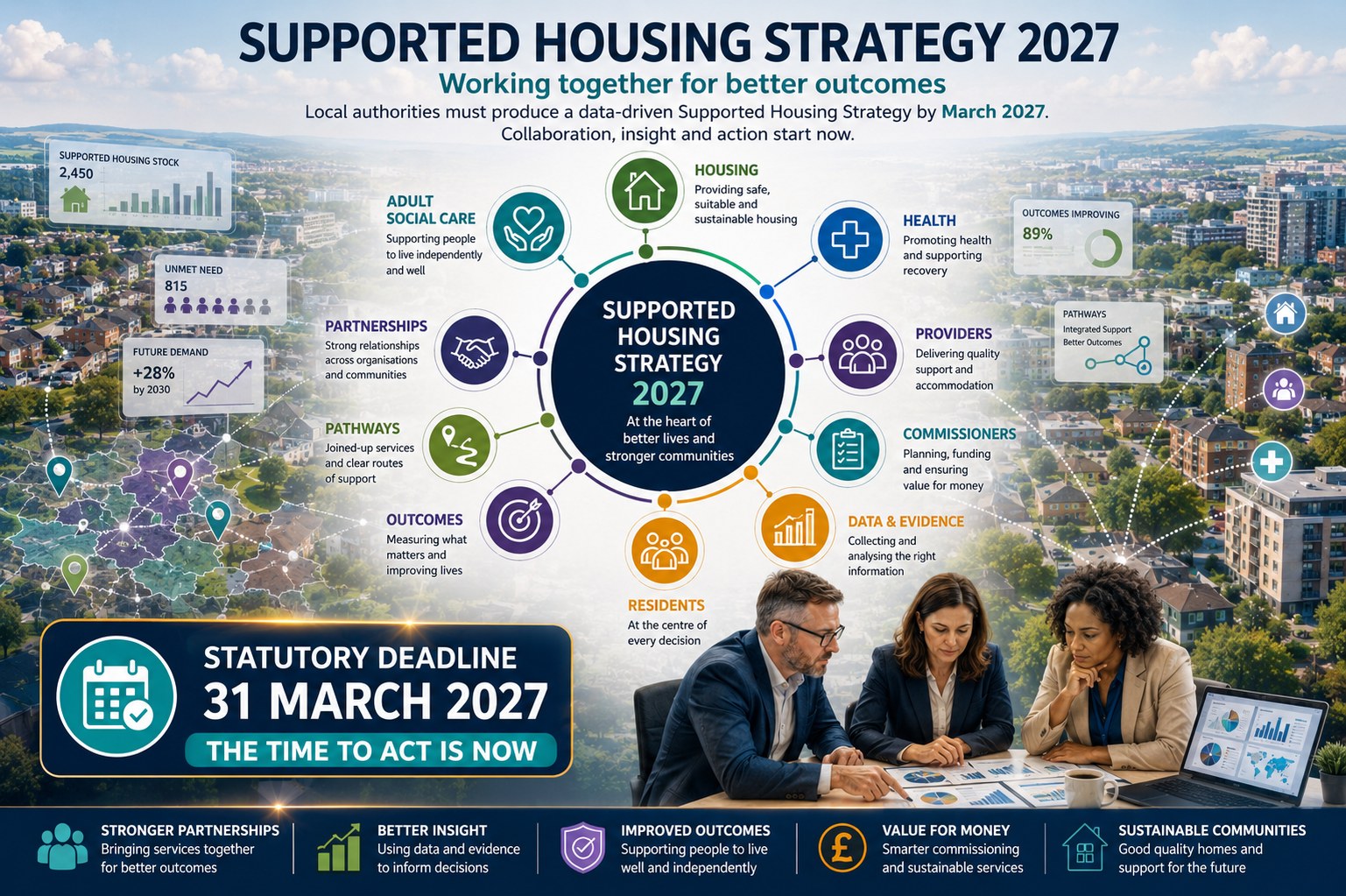
By March 2027, local authorities across England will be required to publish a Supported Housing Strategy as part of the Supported Housing (Regulatory Oversight) Act.
For many councils, this may appear to be another strategy document to add to an already crowded policy landscape. In reality, it could become one of the most significant housing, care and support challenges facing local authorities over the next two years.
The reason is simple.
The legislation is not asking councils to produce a document. It is asking them to demonstrate a clear understanding of supported housing need, future demand, market capacity, partnership arrangements and resident outcomes across their area.
That requires evidence.
And evidence requires data.
More Than a Housing Issue
Supported housing sits at the intersection of multiple services.
Housing.
Adult Social Care.
Public Health.
Mental Health Services.
Commissioning.
Homelessness Prevention.
Community Safety.
Historically, many of these services have operated independently, often using different systems, processes and reporting frameworks.
The new requirements challenge organisations to think differently.
Local authorities will need to demonstrate how these services work together, how people move through pathways, where gaps exist and whether current provision is meeting local need.
For many areas, this may be the first time this information has been brought together in a structured way.
The Questions Authorities Need to Answer
To produce an effective Supported Housing Strategy, authorities will need confidence in the evidence that underpins their decisions.
Key questions may include:
- What supported housing provision currently exists across the area?
- Which client groups are being supported?
- Where are the gaps in provision?
- What is the projected future demand?
- What outcomes are being achieved?
- How effective are move-on pathways?
- Where are people presenting repeatedly across services?
- What is the relationship between supported housing demand and homelessness pressures?
Without reliable data, these questions become difficult to answer.
The Challenge of Partnership Working
One of the most significant challenges is likely to be organisational rather than technical.
Housing and Adult Social Care teams often operate under different legislation, funding arrangements and priorities.
Health partners may hold valuable information but have different reporting requirements.
Supported housing providers themselves may range from large commissioned organisations to smaller independent providers.
Creating a shared understanding of need across these groups will require strong leadership, clear governance and practical mechanisms for collaboration.
The authorities that start these conversations early are likely to be in a much stronger position than those who leave preparation until 2026.
Data as a Strategic Asset
The most successful Supported Housing Strategies are unlikely to be written from spreadsheets alone.
They will be informed by:
- Needs assessments
- Outcomes data
- Referral patterns
- Risk information
- Demand forecasting
- Provider intelligence
- Service user experiences
The ability to collect, analyse and report this information consistently will become increasingly important as authorities prepare for implementation of the new framework.
Five Questions to Ask Today
If your authority is beginning to think about Supported Housing Strategy requirements, consider:
- Do we know what data we currently hold across housing, support and care services?
- Can we identify unmet need and future demand?
- Do we have consistent outcomes information across providers?
- Are our housing and care pathways clearly defined and understood?
- Who will lead the development of our Supported Housing Strategy?
The answers to these questions may determine how straightforward the journey to March 2027 becomes.
Looking Ahead
The Supported Housing (Regulatory Oversight) Act represents an opportunity as well as a challenge.
Done well, it has the potential to improve partnership working, strengthen oversight, support better commissioning decisions and ultimately improve outcomes for residents.
The authorities that begin planning now will have more time to build the evidence base, engage partners and develop strategies that are genuinely informed by local need.
The conversation has already started. The question is whether organisations are ready for what comes next.