
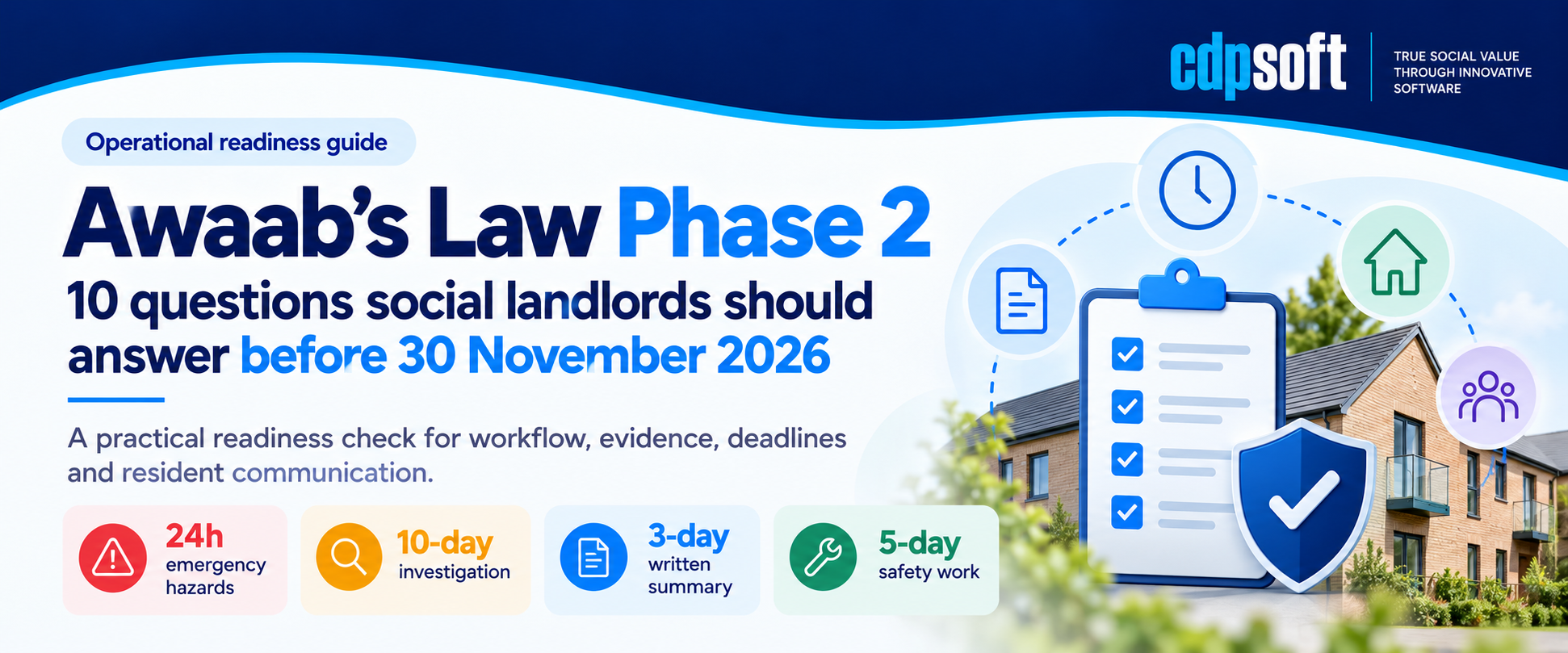
From 30 November 2026, Awaab’s Law Phase 2 is due to extend the significant-hazard requirements beyond damp and mould to include:
- excess cold
- excess heat
- falls
- structural collapse
- fire and explosions
- electrical hazards
- domestic hygiene, including personal hygiene and food safety.
Emergency hazards will continue to be covered across almost all hazard types, with overcrowding excluded.
For social landlords, this is not simply another repairs deadline.
The statutory clock can begin as soon as the landlord becomes aware of a potential hazard, including information received through staff, contractors or other relevant parties. Government guidance therefore recommends clear reporting and escalation procedures and good records of investigations, communications and third-party reports.
That creates a wider operational question:
Can you reliably show what your organisation knew, when it knew it, what happened next and whether the required action took place on time?
Use our 10-point Awaab’s Law
Phase 2 readiness check in your organisation by clicking here.
Phase 2: the key timescales
For a potential significant hazard, landlords will generally need to:
| Requirement | Maximum timeframe |
|---|---|
| Investigate a potential significant hazard | 10 working days from becoming aware |
| Provide the tenant with a written summary | 3 working days after the investigation concludes |
| Undertake relevant safety work | 5 working days after the investigation concludes |
| Begin, or take steps to begin, supplementary preventative works | 5 working days |
| Physical start of supplementary work where it cannot start immediately | No later than 12 weeks |
Emergency hazards are different: both the investigation and relevant safety work must be completed within 24 hours of the landlord becoming aware of the hazard.
If a home cannot be made safe within the required timeframe, the landlord must secure suitable alternative accommodation for the household at its own expense.
These deadlines make the quality of the underlying process increasingly important.
1. Do you know exactly when the clock started?
One of the most important pieces of data may be deceptively simple:
When did the landlord first become aware of the potential hazard?
That may not be the date a repair was formally raised.
A housing officer could see a problem during a visit. A support worker could raise a concern. A tenant could mention something to a contractor. Information might arrive through a call centre, email, portal or another team.
The government guidance makes clear that landlords need procedures that allow relevant information to be reported and escalated appropriately.
A robust process therefore needs to record:
date and time of awareness ? source ? issue reported ? initial assessment ? responsible team ? next deadline.
If that information is spread across emails, contractor systems, repairs records and individual notes, establishing “Day Zero” later may be difficult.
2. Can frontline staff see vulnerability information when they need it?
Awaab’s Law is not simply about categorising a physical defect.
The Phase 2 hazard guidance expects landlords to use professional judgement and consider the circumstances of the household when assessing risk. Age, disability and health conditions may materially change the potential impact of a hazard.
This was also one of the weaknesses identified in the government’s Phase 1 Test and Learn research.
It found that landlords did not always identify or respond to vulnerability at first contact. Where vulnerability was identified, responses tended to be faster and more structured.
Providers should therefore ask whether staff handling an initial report can easily see the information needed to make an informed decision — without requiring residents to repeatedly explain their circumstances.
3. Is triage structured without becoming inflexible?
Professional judgement remains important.
But there is a difference between professional judgement and everyone following a different process.
The Phase 1 research concluded that robust, structured triage, including early identification of vulnerability, led to more proportionate prioritisation and better resident experiences. Poor triage contributed to repeat reports, fragmented responses and inconsistent outcomes.
A useful workflow should therefore prompt the right questions while still allowing appropriately trained staff to make the actual judgement.
Technology should support the decision.
It should not make the legal decision for them.
4. Does someone clearly own the case from beginning to end?
A repair can pass through several teams:
tenant contact ? housing ? inspection ? repairs ? contractor ? specialist assessment ? remedial work ? follow-up.
Every handover creates the potential for delay.
The government’s Test and Learn research found examples of fragmented case handling and slippage between inspection and remedial work. Some landlords were already moving away from individual repair tasks towards more end-to-end case management to create clearer ownership and follow-through.
This is an important distinction.
A landlord may complete each individual task correctly while the overall case still fails.
The question becomes:
Who is responsible for making sure the entire journey reaches a safe and evidenced conclusion?
5. Are the statutory deadlines visible before they are missed?
Recording a missed deadline is useful for audit.
Preventing the deadline being missed is considerably more useful operationally.
For each relevant case, teams should be able to see:
- when the statutory clock started
- investigation deadline
- written-summary deadline
- make-safe deadline
- supplementary-work deadline
- whether alternative accommodation may be required
- whether any action is overdue or at risk.
Managers then need an exception view rather than having to inspect every individual case.
For example:
7 cases due for investigation in the next 48 hours.
3 written summaries outstanding.
2 make-safe deadlines at risk.
1 case awaiting specialist contractor availability.
That turns compliance data into management information.
6. Can you produce the written summary from the case record?
For significant hazards, tenants must generally receive a written summary within three working days of the investigation concluding.
The government’s research found that written inspection summaries were not consistently provided during Phase 1. That reduced transparency and made it harder for residents to understand what had been found, what had been promised and when they should expect action.
Ideally, the information required for the summary should already exist in the case:
investigation date, findings, hazard assessment, immediate action, further work, expected timescales and resident advice.
Producing the communication should be the final step of the workflow — not another manual exercise requiring somebody to reconstruct the case.
7. Is the evidence stored with the case?
A good case record should provide a coherent evidence trail.
Depending on the circumstances, this might include:
- photographs
- inspection records
- contractor reports
- resident communications
- hazard assessments
- appointments
- attempts to gain access
- make-safe actions
- repair records
- decisions and reasons
- alternative accommodation arrangements
- follow-up checks.
Government guidance strongly advises landlords to maintain clear records of engagement, investigations and communications.
This has value beyond demonstrating compliance.
It allows a different member of staff to understand the case without asking the resident to start again.
8. What happens if another team or contractor discovers the hazard?
Individual case management is one part of the picture.
The data can also help landlords understand:
- recurring hazards
- properties with repeat reports
- geographical patterns
- contractor performance
- average investigation time
- missed or near-missed deadlines
- households requiring additional support
- repeat damp, mould or environmental problems
- cases requiring alternative accommodation.
That information can help shift the response from:
“Did we complete this repair?”
to:
“Why does this problem keep happening, and where should we intervene earlier?”
10. Have you tested the process from the resident’s perspective?
The government’s Phase 1 research is particularly valuable here.
Residents did not judge the process solely by how quickly a repair order was created.
Their experience was affected by communication, continuity, whether their circumstances were understood, whether commitments were followed through and whether they knew what was happening next.
A useful readiness exercise is therefore to take a realistic case and follow it all the way through your organisation.
Start with the first report.
Then ask:
What does the resident experience at each stage?
Where are they asked for information twice?
Where could the case disappear between teams?
Where could a deadline be missed?
Where does someone have to copy information manually between systems?
Where would a manager have difficulty seeing that the case has stalled?
Those are often the places where process and technology need attention.
What does this mean for supported housing and temporary accommodation?
There is an important distinction here.
Phase 2 relates to the existing Awaab’s Law regime for social housing.
On 9 October 2026, the government separately opened a consultation on extending Awaab’s Law to accommodation occupied under licence. The consultation specifically references supported housing, temporary accommodation for homeless households and care-leaver accommodation.
That does not mean those licensed settings are already subject to the proposed new requirements.
But providers operating those models should watch the consultation closely because similar operational questions around hazard reporting, evidence, timescales and resident communication could become increasingly important.
Read the government consultation on extending Awaab’s Law to licences
Where technology can help
Technology cannot determine whether a property meets the legal definition of a significant or emergency hazard, and no case-management system can guarantee legal compliance.
What technology can do is make a strong process easier to operate consistently.
For organisations already using CDPSoft, that could include reviewing how the existing platform is configured to support:
structured reporting ? vulnerability information ? assessment and triage ? case ownership ? automated workflow and due dates ? evidence and documents ? resident communications ? remedial actions ? management reporting ? closure and follow-up.
That may not require replacing existing repairs or asset-management systems.
The more important question is whether the information, people and processes surrounding them are sufficiently joined up.
A useful first step before 30 November
Take five recent hazard cases and try to answer these questions:
- When did we first become aware of the issue?
- What did we know about the resident and household?
- Who decided how serious it was?
- Who owned the overall case?
- Can we see every relevant deadline?
- Can we see what the resident was told?
- Is the investigation evidence in one place?
- Can we demonstrate when the property was made safe?
- Can a manager immediately identify cases at risk of missing a deadline?
- Could another member of staff understand the complete history without asking the resident to tell their story again?
If those answers require several systems, emails, spreadsheets and conversations with individual members of staff, Phase 2 may be a useful reason to review the workflow now rather than after 30 November.
How CDPSoft can support the review
CDPSoft works with housing, homelessness, care and support organisations to configure case-management, workflow, data and reporting around their operational processes.
If you already use CDPSoft, we can review how your current configuration supports the information, workflow, evidence and management oversight required around Awaab’s Law and identify whether you can make greater use of functionality you already have.
If you would like to discuss your current process, get in touch with us.
Additional resources: