
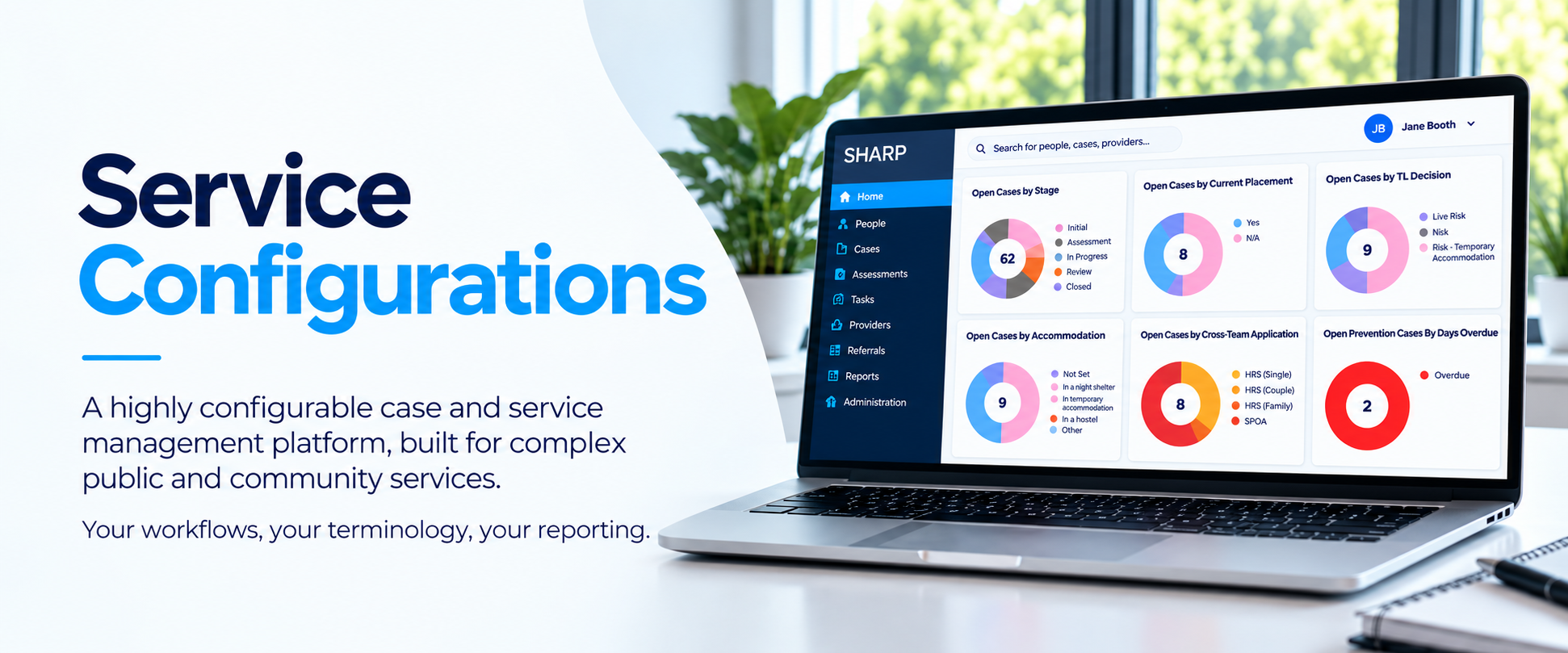
No two services work in exactly the same way.
A housing options team does not operate like a domestic abuse service. A multi-agency referral hub has different processes from an employment support programme. Even two organisations delivering broadly similar services may use different terminology, assessments, referral routes, reporting requirements and measures of success.
Yet organisations are often expected to fit all of that complexity into software designed around a predetermined process.
CDPSoft takes a different approach.
SHARP is designed as a highly configurable case and service management platform. It can be configured around the service being delivered, the people using it and the information that needs to be captured, managed and reported.
One platform. Different ways of working.
Configuration is more than changing a logo or adding a few fields.
Within SHARP, organisations can configure areas including:
- terminology
- forms and assessments
- workflows
- permissions
- data capture
- reporting
That means the technology can reflect how a service actually operates.
A referral pathway can follow the stages used by the organisation. Assessments can capture the information the service needs. Different users and partner organisations can be given appropriate access and permissions. Reporting can be designed around the outcomes, performance measures and statutory requirements that matter to the service.
Supporting more than traditional case management
For many organisations, managing a service involves considerably more than maintaining a client record.
There may be referrals to triage, assessments to complete, properties to manage, tasks to allocate, partner organisations to work with and outcomes to evidence.
SHARP can bring these elements together within the same platform, including case management, referrals and workflows, configurable forms and data capture, properties and services, multi-agency working, and reporting and outcomes.
This allows a single technology platform to support a specialist service, several teams or more complex multi-agency delivery.
Different services need different configurations
The same underlying platform can therefore be configured for very different areas of service delivery.
CDPSoft works across areas including housing and homelessness, referral hubs and Single Points of Access, social care and community support, safeguarding, health and recovery, employment support, independent living and commissioning.
The important point is not that every organisation uses every feature.
It is that organisations can use the functionality appropriate to their service and configure it around their operational requirements.
Configuration also matters when services change
Services rarely remain static.
Funding changes. Partnerships develop. New reporting requirements emerge. Teams restructure. Commissioners ask for different evidence. New programmes are introduced.
Technology needs to be able to respond.
For organisations operating multiple services, SHARP can provide a common technology platform while retaining the configuration required by individual services. As services, partnerships and reporting requirements evolve, those configurations can evolve too.
This is particularly important for organisations trying to balance consistency of technology and data with the reality that different teams still need different ways of working.
See how Service Configurations works
CDPSoft has created a new Service Configurations page showing the different elements that can be brought together within SHARP and the range of services the platform can support.
If your organisation manages people, cases, referrals, assessments, actions, outcomes, properties, partners or reporting, explore how SHARP could be configured around your service.
Explore CDPSoft Service Configurations
Or contact CDPSoft to discuss the requirements of your service.