
The Supported Housing (Regulatory Oversight) Act 2023 is changing how supported housing will be regulated in England.
Much of the focus so far has been on Local Supported Housing Strategies and the Government’s planned March 2027 publication date. But the strategy is only one part of the picture.
The Act also provides for new National Supported Housing Standards and a licensing regime. Together, these changes will increase the importance of local authority oversight of supported housing providers, properties and the support being delivered.
This raises a practical question: How will local authorities manage the new Standards, and will they really need another system to do it?
What are the National Supported Housing Standards?
The Act provides the legislative framework for standards covering supported housing accommodation and the care, support or supervision provided to residents.
The detailed regulations and guidance are still being developed, so it would be premature for any technology provider to claim that a system meets every final requirement.
What is much clearer is the infrastructure local authorities will need.
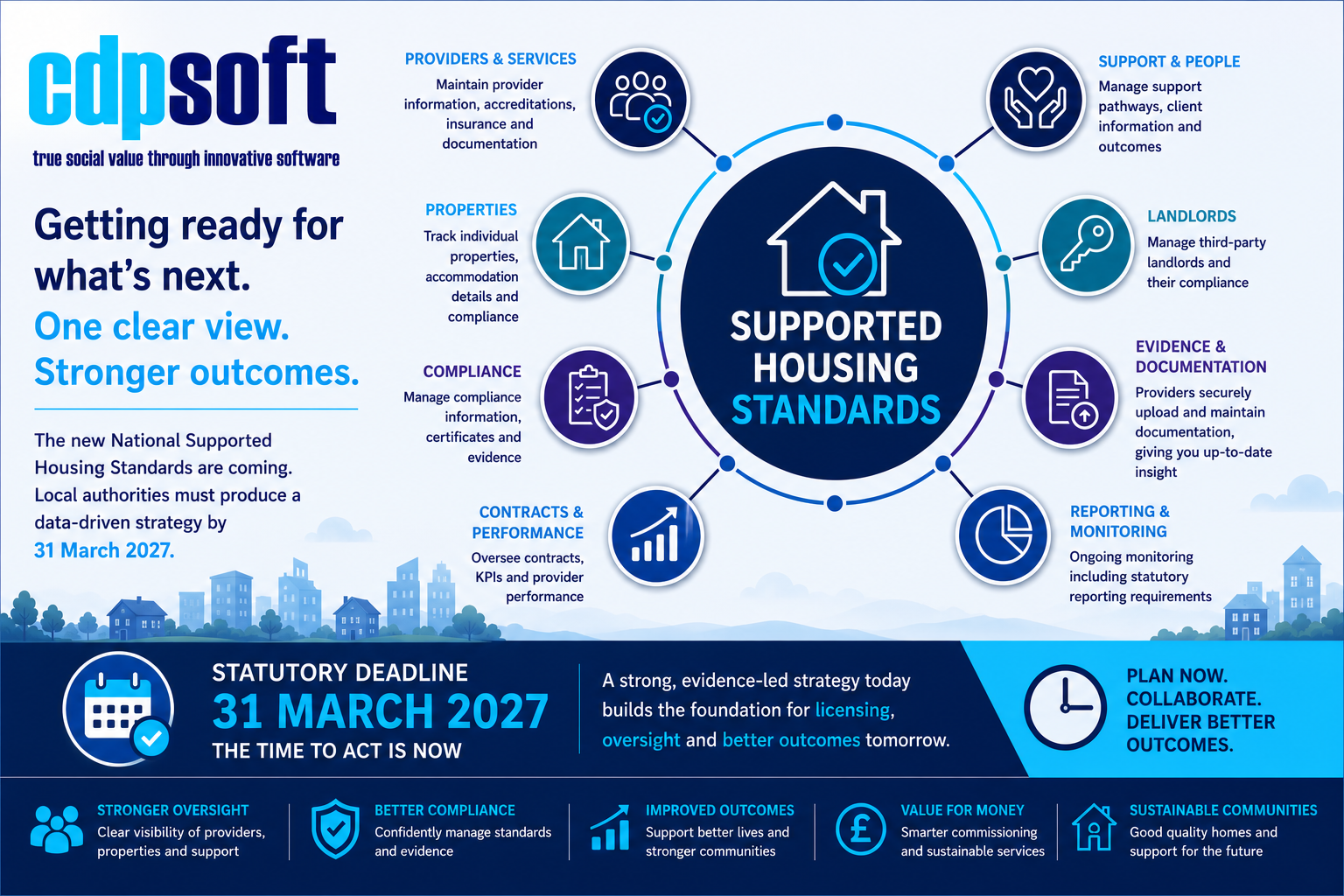
Commissioners need to understand and evidence the relationship between providers, services, properties, landlords, contracts, people receiving support, compliance, performance and outcomes.
That is important because supported housing isn’t simply another part of general needs housing management.
A significant and complex sector
The Government’s Supported Housing Review estimated around 535,400 supported housing units in England in 2023.
Across Great Britain, the estimate rises to approximately 634,000 units, supporting people including older people, people experiencing homelessness, people with learning disabilities and autistic people, people with mental health needs and young people leaving care.
The estimated annual accommodation cost associated with supported housing was approximately £4.09 billion.
Effective oversight of a sector of this scale requires more than collecting documents ahead of a reporting deadline.
It requires an ongoing, structured view of providers, properties, support and performance.
Read the Government’s Supported Housing Review 2023
From collecting evidence to managing compliance
There is an important difference between having compliance information and actively managing it.
Knowing that a certificate exists is useful. Knowing which provider and property it relates to, when it expires and whether updated evidence has been supplied is considerably more useful.
The same principle applies to provider documentation, landlord information, contractual requirements and performance measures.
Providers also need to be part of that process. Controlled access allows them to maintain information and upload evidence while commissioners retain oversight.
This is already familiar territory for CDPSoft customers
CDPSoft has worked in housing-related support and supported housing for more than 30 years.
Managing providers, services, properties, landlords, contracts, compliance, support pathways, performance and outcomes is therefore not functionality being designed in response to the latest regulation.
Depending on local requirements, authorities can already use CDPSoft to manage:
• supported housing providers and services
• individual properties and accommodation
• third-party landlords
• provider accreditations, insurance and documentation
• property compliance information
• support pathways and client information
• contracts, KPIs and provider performance
• compliance evidence
• ongoing monitoring and statutory reporting
Providers can also have controlled access to maintain and upload their own information.
For existing CDPSoft customers, the underlying capability is already there.
The final Standards will determine precisely which information needs to be collected and evidenced. Adding those requirements to an established structure for managing providers, properties and services is very different from designing a new system around the regulations.
Build around supported housing, not the regulation
This is perhaps the most important consideration for local authorities reviewing their technology requirements.
Regulations evolve.
The underlying system therefore needs to reflect how supported housing itself operates, rather than being built around one particular regulatory requirement.
If providers, properties, landlords, services, contracts, clients, compliance and performance are already structured correctly, new requirements can be incorporated as they emerge.
Before investing in another system or module, authorities should therefore ask:
How much of this can we already manage within our existing supported housing infrastructure?
For some authorities, that will identify gaps.
For existing CDPSoft customers, considerably more may already be in place than they realise.
The regulatory framework is changing, but managing providers, properties, compliance, support and performance has always been fundamental to what CDPSoft does. Our customers are already using these capabilities as part of their day-to-day management and oversight of supported housing.
Find out how ready you are
CDPSoft can work with existing customers to review how their current configuration can support the developing National Supported Housing Standards.
For other local authorities, CDPSoft can demonstrate how provider, property, compliance, support and performance information can be managed within a dedicated supported housing environment, without unnecessarily duplicating information across other systems.
Further reading
National Housing Federation. The Supported Housing (Regulatory Oversight) Act
UK Government. Supported Housing Regulation Consultation: Government Response
UK Government. Supported Housing Review 2023
UK Government. Local Supported Housing Strategies