
Published: 19 October 2026
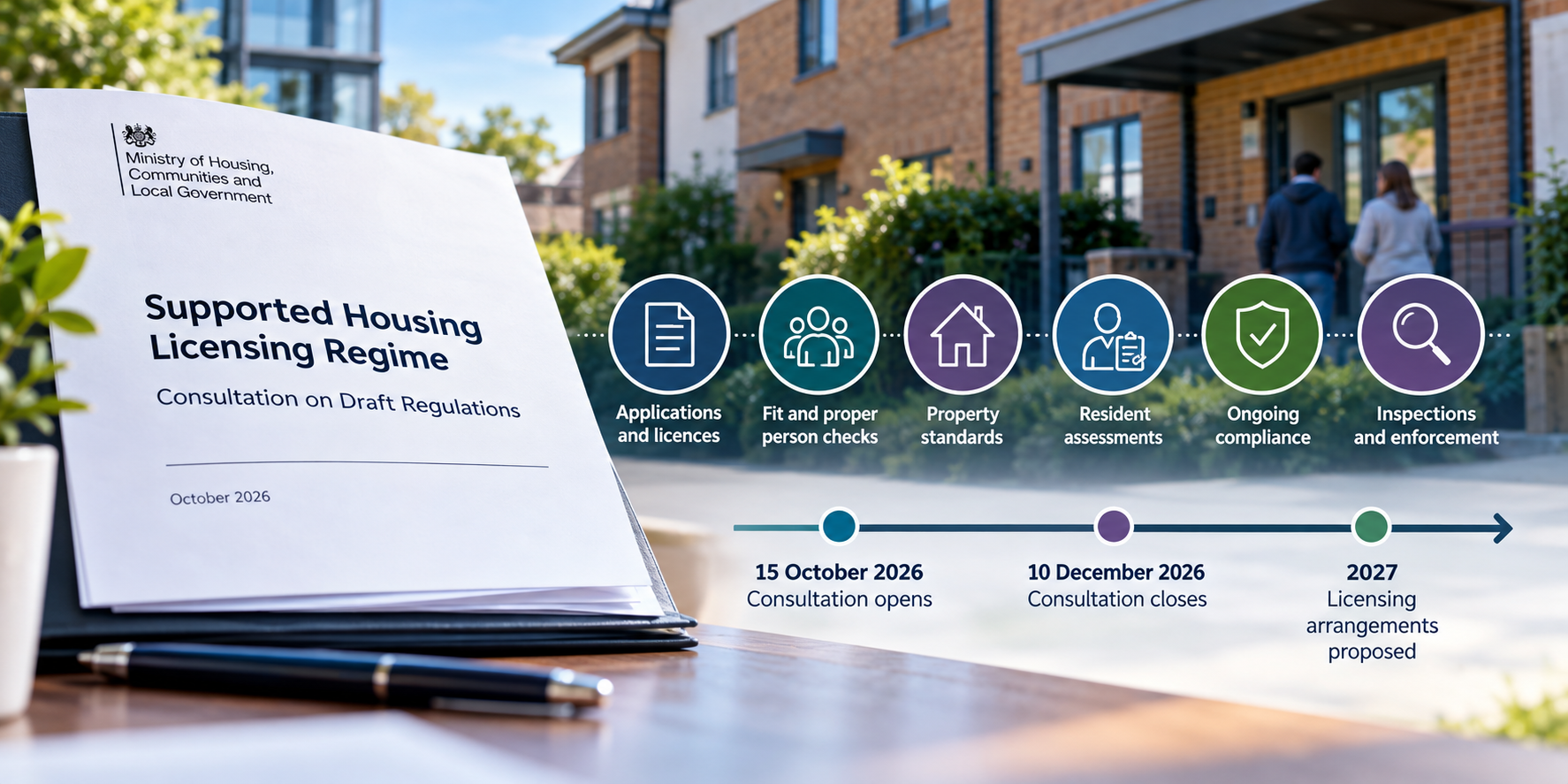
Key dates: Consultation opened 15 October 2026 | Responses close 10 December 2026 | Licensing arrangements proposed for 2027
On 15 October 2026, the Ministry of Housing, Communities and Local Government (MHCLG) published its consultation on the draft Supported Housing Licensing Regulations.
This is an important development in the implementation of the Supported Housing (Regulatory Oversight) Act 2023.
Until now, much of the discussion has focused on what the new regulatory framework will mean for supported housing. The latest consultation provides considerably more detail about how licensing would operate, what evidence providers would need to supply and how local authorities would oversee compliance.
For local authorities and supported housing providers, the question is becoming less about what the legislation intends to achieve and more about how it will work in practice.
What has changed?
The Government has now published draft regulations setting out the proposed structure and operation of the new licensing regime across England.
The proposals include:
- National licensing coverage. The Government intends to designate every local housing authority in England as a supported housing licensing district.
- Five-year licences. Licences would identify the responsible licence holder, the properties covered and the mandatory conditions that must be maintained.
- Fit and proper person checks. Licence applicants and relevant nominated individuals would need to demonstrate their suitability, capability and financial standing.
- Resident needs assessments. Each resident would need an assessment on moving in or within four weeks of moving in.
- Ongoing compliance. Providers would need to demonstrate that accommodation, management arrangements and support meet the relevant requirements.
- Enforcement powers. Authorities would have powers to request information, inspect accommodation, issue notices, impose financial penalties and revoke licences.
- Records and transparency. Authorities would need to maintain records of applications, licences and enforcement activity, with defined publication requirements.
These are proposals, not regulations already in force. The consultation closes on 10 December 2026, after which the Government will consider responses before laying regulations before Parliament.
The full proposals are available in the draft regulations consultation document.
Licensing will require more than an application process
One of the most significant aspects of the proposals is the relationship between licensing and ongoing oversight.
A licensing authority would need to establish whether an application meets the requirements for approval. But its responsibilities would not end when the licence is granted.
The proposed framework provides for continuing oversight of licence conditions, changes to management arrangements, accommodation standards and the quality of support provided.
That creates an operational requirement to understand and maintain information about:
- Providers, landlords and their legal responsibilities.
- Individual properties, accommodation types and units.
- Licence applications, decisions, conditions and renewal dates.
- Management arrangements and nominated individuals.
- Property standards and compliance documentation.
- Resident assessments and support arrangements.
- Inspections, concerns, improvement actions and enforcement history.
For providers, much of this information may already exist.
For local authorities, the challenge may be bringing it together in a consistent, accessible and auditable way.
This is particularly relevant where supported housing involves multiple providers, third-party landlords, commissioned services and different council departments.
An important detail: resident assessments within four weeks
Among the proposed mandatory licence conditions is a requirement for every resident to have their needs assessed when they move in or within four weeks.
The assessment would need to be completed by an appropriately skilled person and meet the relevant National Supported Housing Standards.
This is a practical example of how the licensing framework connects accommodation management with the delivery of support.
It raises questions about how providers manage referrals, assessments and ongoing support, and how they can evidence that requirements have been met.
For example:
- Can the provider demonstrate when the resident moved in, when their assessment was completed and who completed it?
- Can assessment information inform the support being delivered?
- Can relevant evidence be retrieved without searching across multiple documents or systems?
The requirement is not simply to hold information. It is to demonstrate that the appropriate activity has taken place.
For residents, this should ultimately support more consistent, person-centred services, with their needs understood and appropriate support arranged.
What does this mean for local authorities?
In our earlier article, The 2027 Supported Housing Strategy Deadline: Why Data, Partnerships and Planning Need to Start Now, we explored the importance of understanding local provision, future demand and the effectiveness of existing support arrangements.
The licensing proposals add another dimension.
Authorities will increasingly need to connect strategic intelligence about supported housing provision with operational oversight of the organisations and properties delivering it.
The draft regulations propose that licensing authorities maintain records of applications, decisions and enforcement actions.
They would also need to publish specified information about licence holders and revoked licences, while protecting sensitive accommodation locations.
This creates a distinction between information that can be published, information needed internally for regulatory oversight and sensitive information that requires appropriate access controls.
The underlying challenge is not necessarily collecting more data. It is ensuring existing data is structured, maintained and available to the people who need it.
For authorities already managing supported housing providers, services, properties and contracts, there may be opportunities to build on existing arrangements rather than establish separate processes for every new requirement.
What about exemptions?
The draft regulations also set out categories of accommodation that may be exempt from licensing.
These include certain older people’s supported housing, directly provided local authority accommodation, qualifying domestic abuse refuges, almshouses and specified accommodation linked to criminal justice or Ofsted-regulated provision.
However, there is an important distinction.
Under the proposals, accommodation falling within an exemption category would still need to apply to the licensing authority for confirmation of that exemption.
This means authorities would need a process for receiving and determining exemption applications, recording decisions and managing changes where an exemption no longer applies.
Providers should therefore review the detailed eligibility criteria rather than assume that their organisation or accommodation type will automatically be exempt.
The implementation timetable: what happens next?
The Government proposes a phased implementation.
Once the Secretary of State designates licensing districts, local housing authorities would have six months to establish their schemes.
A further three-month transition period is proposed before operating without a required licence becomes an offence.
The draft regulations also include a process allowing existing providers to address identified deficiencies during the transition.
The exact commencement timetable remains subject to the regulatory process. The proposed preparation and transition periods should not be treated as fixed calendar dates until the relevant arrangements are confirmed.
In the meantime, there are three important milestones:
15 October 2026: Draft licensing regulations published.
10 December 2026: Consultation closes.
31 March 2027: The Government’s currently planned deadline for first Local Supported Housing Strategies, subject to the relevant regulations.
The strategy and licensing requirements are related, but they are separate duties with different implementation arrangements.
Five questions worth asking now
Local authorities and supported housing providers do not need to wait for the regulations to be finalised before reviewing their existing arrangements.
Five useful questions are:
- Do we have an accurate view of supported housing provision? Can we identify providers, properties, services, landlords and the relationships between them?
- Can we manage licensing and exemption decisions consistently? Do we have processes for applications, supporting documents, decisions, conditions and changes?
- Can we demonstrate ongoing compliance? Can we record evidence, monitor expiry dates, identify issues and track actions through to completion?
- Can we evidence the support residents receive? Are assessments, support arrangements and outcomes recorded appropriately, with access restricted to authorised users?
- Can our existing technology accommodate new requirements? Or are we at risk of creating another standalone system that duplicates information already held elsewhere?
These questions apply whether an organisation manages a small number of schemes or oversees a complex supported housing market.
Building on existing infrastructure
Our previous article, National Supported Housing Standards: Building the Right Infrastructure for Compliance, explored why effective oversight depends on connecting information about providers, properties, services, compliance and outcomes.
The draft licensing regulations reinforce that argument.
CDPSoft has supported housing-related services, commissioning arrangements and multi-agency working for more than 30 years.
Its configurable technology already supports a range of relevant activities, including managing providers and properties, maintaining documentation, recording assessments, coordinating support and producing management information.
For existing CDPSoft customers, the priority may be to review what is already available within their current configuration and identify what additional processes or information the final regulations will require.
For other authorities and providers, the opportunity is to consider whether licensing, provider monitoring and supported housing management can form part of a more connected approach.
It would be premature to claim that any system is fully compliant with regulations that have not yet been finalised.
However, the underlying capabilities required to manage information, evidence, workflow and accountability are already well established.
A more connected approach to supported housing oversight
The 2023 Act, National Supported Housing Standards, Local Supported Housing Strategies and proposed licensing regime are different elements of a wider programme of reform.
Together, they point towards a more structured approach to understanding supported housing provision, protecting residents and demonstrating the quality of accommodation and support.
The intention is not simply to create another administrative process.
It is to improve confidence that supported housing is safe, appropriate and genuinely meeting people’s needs.
For local authorities and providers, the practical challenge will be implementing these arrangements proportionately while maintaining the services that residents depend on.
The organisations best placed to respond will be those that understand their existing provision, know where their information sits and can demonstrate how services are being managed.
Have your say before 10 December 2026
The Government is inviting views from local authorities, supported housing providers, commissioners, residents and other interested organisations.
Read the consultation and respond before 10 December 2026.
How CDPSoft can help
CDPSoft can work with existing customers to review how their current systems and configurations could support the developing licensing requirements, alongside provider management, property oversight, compliance monitoring and service reporting.
For authorities and providers exploring their options, CDPSoft can demonstrate how these activities can be supported within a configurable, connected information management environment.
Contact CDPSoft to discuss supported housing management and licensing readiness.
Further reading and official sources
MHCLG: Supported Housing Regulation Consultation and Government ResponseFrom 30 November 2026, Awaab’s Law Phase 2 is due to extend the significant-hazard requirements beyond damp and mould to include:
MHCLG: Supported Housing Licensing Regime Consultation, 15 October 2026
MHCLG: Detailed Draft Regulations and Consultation Questions
MHCLG: Local Supported Housing Strategies Statutory Guidance